
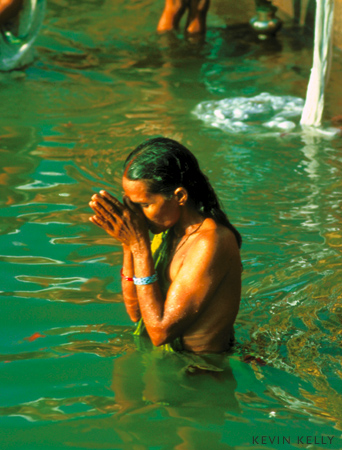

Baptism in the Ganges
Varanasi, India
Pilgrims by the hundreds of thousands come to wash themselves in the river Ganges. They prepare themselves along the steps at riverside and then step into the flowing river in a kind of baptism, praying in still quietness. Here at sunset a women bows in gratitude.
Share your story
Tomas Powell writes:
This woman has red dye in the parting in her hair - this shows that she is married, and comes from the traditional Indian idea of Dilvale dulhania le jayenge - the courageous takes the bride - an idea that arose after stories of birdes being stolen in the middle ages just before their weddings. Their groom to be would save them and slay their capters, then smothering the dead villains blood in their brides hair - nice!
Srinivasa Phanindra writes:
Sindoor is vermilion, powdered red, applied as a dot on the forehead, like the regular ‘bindi or in the parting of the hair by all married women. It is a visible expression of their desire for their husbands’ longevity. Traditionally therefore, widows did not wear vermilion.
Red is the color of power. Vermilion is thus a symbol of the female energy of Parvati and Sati. Sati is believed to be the ideal wife, one who gave her life for her husbands’ honor. Every Hindu wife is supposed to emulate her. It is believed that Parvati protects all those men whose wives apply vermilion to their parting of hair.
Sindoor is applied for the first time to a woman during the marriage ceremony when the bridegroom himself adorns her with it. Sindoor-dana, as this part of the marriage ceremony is called, is important today but it is a relatively new practice.
The Ganges ( The river Ganga) is said to purify any soul that dips in it. The women is attempting to the same to herself and her husband whom she adorns on with sindoor.