


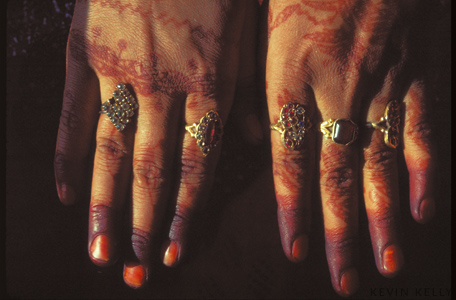



Henna-dye on woman's hand
Sitting on a bus, Pakistan
The art of painting hands and feet with henna dye is widespread in the mid-east and south Asia. Henna patterns, which fade slowly, are a temporary tattoo; many of the patterns are similar to idigenous tattoos. It is primarily a women's art. Because women are more secluded in Pakistan and Iran, the chances of seeing it are infrequent. I was able to view this woman's hands while sitting across from her in a third-class carriage on a train. I love her matching rings.
Share your story
Your Story
You may know more about this scene than I do, or you may have an amazing story revolving around a similar thing you saw. I'd love to hear it. Submit your story below, and if it's appropriate I'll post it here for all to read. For the benefit of a larger audience, please use English, even if it is not the best English.