

Asia Grace


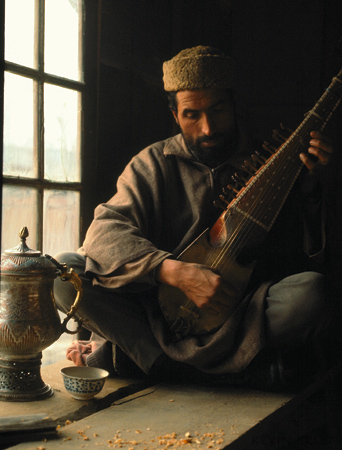
Rahab player

Srinagar, Kashmir

I was staying on a houseboat in Srinagar. On a neighboring houseboat a carpenter was preparing the elaborate wood carvings that adorn these famous boats. He took a break by pulling out his Kashmiri guitar, or Rahab. That is a samovar filled with Kashmiri-style ea (heavy milk and sugar) next to him.

Share your story

Order this print


Share your story


Type the characters you see in the picture above.


Reader Stories

Daniel O'Donnell writes:

When I saw this photograph, I was floored. The woodcarver is playing a rabab, an ancient instrument found in present-day Pakistan, Afghanistan, Kashmir, and Iran. It has been used almost exclusively for Sufi music for at least three centuries.

Allyn Miner has written a book about this instrument and its relationship to the modern sarod of India, of which it is probably a predecessor. I happen to own two, one of them at least 200 years old, which I acquired from a carpet-dealer in San Francisco in the 1970s: he was allowed to take two out of Afghanistan. In my travels, I have found only a dozen in the United States, and good recordings of this instrument are few in number (I probably have all the ones available, due to constant searching).

I was very fortunate to have a teacher for rabab in the person of Ustad Hashim Chishti of the CHishti Sufi teaching lineage. He had been brought to America by Zuleikha and her then-partner Yusuf. When I showed him mine, he looked through a tiny hole in the goatskin soundboard and said to his interpreter, "Tell him there are eggs inside". I thought he was making a joke, and he was very insulted I did not look. Eventually, I did look, and surely enough, there were four little emptied-out partridge eggs glued inside, facing up like little espresso cups. As the weeks went by, I gradually learned that the eggs symbolize transformation on the Sufi path, insofar as a bird is born twice: once when the egg is laid, and then when it breaks out of the shell. There is usually a bird-head motif to the pegbox of the Afghan rabab, and the string holders at the end are usually also carved in the shape of a bird's head.

The odd thing is, when I play mine, I usually also drink tea from a small blue-and-white Chinese porcelain bowl, just like in your photograph!

- Daniel O'Donnell