
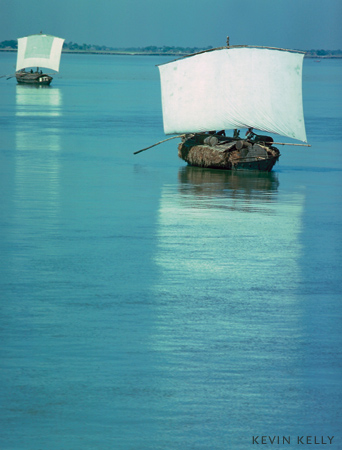

Asia Grace


Sail Barges

Ganges delta, Bangladesh

In the delta of Bangladesh, where the Ganges and Brahmaputra rivers meet, sailboat barges haul goods long-distance.

Share your story

Order this print


Share your story


Type the characters you see in the picture above.


Reader Stories

Andrew Grant writes:

In December of 1979, I flew to Dacca, Bangladesh, where I had an Uncle working for FAO of the UN. He was a fisheries biologist, and he was there essentially training Bangali's to count fish. The Bangali Government wanted to know how many fish were being caught in the country, but had no system in place to do this, and FAO was there training Bangali's as fisheries officers to go around the country-side weighing and counting fish so that some estimate could be made of the fish catch (a hopeless task I would think in a country of 130 million in an area of my home province of New Brunswick, which has 600,000 people in it).

One day, my uncle and I and a couple of the Bangali fishery officers, were invited to go 'fishing' with a couple of the local fisherman that lived in a small village along the banks of the Brahmaputra River. We set out in two boats, basically dugout canoes with a tiny mast in them, in the middle of the morning. The two boats, my uncle in one and me in the other, joined up in the middle of the river (you could hardly see from one side to the other it was so wide) and tied their fishing net, which was a gill net, together and then rowed apart for opposite shores. The net must have been close to a mile long. We drifted down river for over an hour, then the fishermen pulled the nets in coming togther again in the middle of the river. Sadly, we didn't catch one fish! However, during this time, an armada of over 80 such boats as in your photograph, loaded with jute (basically hemp) sailed down the river heading for Chittagong.

At various times during this adventure in the backwaters of Bangladesh we found ourselves in tiny villages where most children (maybe even adults) had never seen a white person. If I stopped to talk, within 5 minutes there would be 100 children gathered around staring at me. We also saw people pulling these boats up-stream along the banks of the river. Two or three fellows on the shore pulling a long rope tied to the mast, with one fellow asleep at the tiller just keeping her bow off-shore. And off course, seeing those fellows pull those boats, and they do it for hundreds of miles if the wind is from the wrong direction, is reminiscent of the famous painting by Repin called "The Volga Boatman" and the haunting song by the same name.

While I'm here, I would like to relate to you an event that happened near the end of that trip through the backwaters of Bangladesh that was the source of much discussion when I got home to Canada. My uncle and I were sailing (with a Bangali) from one village to another, down the Brahmaputra, in a little dugout canoe (maybe 14 ft long), with a tiny thatched cabin and a mast for a sail. The sail had more patches than sail. The main sheet was so worn and tied, like bailing twine. Well, the main sheet broke in a little gust. The skipper somehow managed to round up into the wind, catch the twine and tie the two ends together yet again, and then head down river. And my thought was "these guys have been fishing like this for 500 years, and they're doing it almost the same way. I've fished herring with another Uncle on an 85 foot carrier with the Grand Mannan fishing fleet on Georges Bank of southern Nova Scotia, and we don't depend on little threads of bailing twine. The seiners are fishing at night with sonar, trying to find schools of herring (as it happens, no fish were caught that night either!). The West has developed so rapidly in 500 years, and this Bangali hasn't changed a bit. It was the same question that struck Jared Diamond in Guns, Germs and Steel. I only really found an answer after reading that book. Do you know what I mean?

And apparently, the World Bank in its great wisdom, has decided that Bangladesh should not export jute anymore (one of its few natural resources and exports), because it costs the country too much, and the world Bank can't get paid its interest. So all those sailors are up the crick without a paddle!