
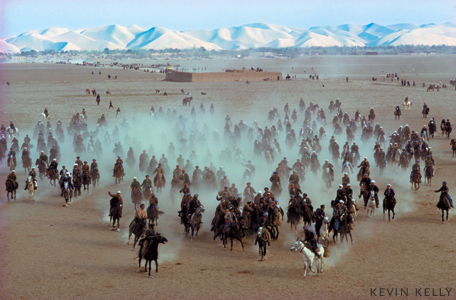

Buzkashi game
near Kholm, Afghanistan
Traditionally this game is played on Friday afternoons (the Muslim "Sunday") on an empty field out of town. The goal of the game is to pick up a goat or calf carcass and haul it around a distant pole and then dump it back into a circle. The person (or team) who manages this wins that round. Everyone else is trying to stop you and do it themselves. There appear to be no other rules. A short hand for the game might be "a free-for-all" on horses, although a literal translation of buzkashi (spelled different ways) is "goat ball."
Games can entail dozens or hundreds of participants. Each round is financed by a sponsor, so the winner is given cash. He struts his horse forward to the tent where the big-wigs sit, and he is handed the money. Both the pros (who travel town to town) and the locals play in the same game.
So where did I take this picture from? I was sitting on a hillside, much like the one across the valley, where all the other men were sitting (no women), almost like stadium seats. It was late afternoon in early winter, when there was more free time for such pursuits.
Share your story
lilli holm writes:
This must be a buscatchi in Afghanistan. I went to see one in the year '73 and was alomost killed. It was up in the north and bustcatchis were not allowed but still took place. By word of mouth we got to know about it. It was a huge plain field and we parked our Range Rover somewhere outside. It was hundreds of men on small horses, lots of dust and noise. I was the only woman around. In jeans and teeshirt I must admit. My two freinds and I saw something in the back that look like a tribunal, a place where viewers could sit and look at the spectacle. Oh European stupidity. So we said okay lets go there. We started and all the horseback riders came towards us to look who was coming. They galloped and 30 centimeters before us they stopped their horses. They came closer and closer. One friend had gone back to the car to get the camera. The other said to me "I am afraid." "So am I," was my answer, and we satarted running towards that platform.
I landed in the dust several times; I had to get up and start running again. The riders and the onlookers came closer and closer and became more and more angry. All of a suddden a young man in uniform came to and grabbed me hard by the arm and said I had to leave immediatly, this would be too dangerous. He took me back to the car.
For the rest of the buskatchi the crowd shook the car and tried turn it over. I suvived and still love the country, the wild and proud men and everything I saw in Afghanistan. (I am German , so please excuse my bad English).
Nurlan Almabaev writes:
Buzkashi is a popular game not only in Afghanistan but also in the rest of Central Asia. I think origins of this game go back to turko-mongolian rule.
In Kyrgyzstan, Buzkashi is called KOK BORU or ULAK TARTYSH (wrestling on horseback for a goats carcass). There is an interesting story about Kok-Boru (Buzkashy) in Kyrgyzstan.
"The words "kok-boru" mean, "gray wolf". The origin of this original game is very ancient. It originated in those remote times when herds of cattle grazed in the steppes and mountains all year round without a shelter or top dressing exposed to the attacks of wolves. Having no firearms the shepherds could not deal with wolves on the spot. Brave nomads chased after the wolves until the beasts of pray ran off their feet, then began beating them with sticks and lashes, trying to snatch them away from each other. Later "kok-boru" was replaced by "ulak tartysh''. At present time this game is played on green meadows of high mountain pastures as well as on racecourses. To seize a goat's carcass in the center of the field and deliver it into the gates of the contesting team is the objective of the game."
Karen writes:
Strange how the world works - I read about Bukzashi in a romance novel of all places, by this author, Mary Jo Putney. I think the book is called Silk and Thunder.
It's a really old game that's been played for at least half a millenia.
Tim writes:
James Michner's book Caravans, a novel set in Afganistan, has a long and detailed description of a game, which is how I learned about it
Peter Flindell writes:
I've been to a few events like this in Tajikistan. This is a slightly different game there, but wonderfully exciting. You can see my photojournal at http://www.untamedlens.com/tajikbuzkashi/tajikbuzkashi.html
Marsulas writes:
Buzkashi was part of the everyday lives of Aryans. Aryans were strong people like Afghans (the word AFGHAN came from ARIYAN) who invaded Iran Central Asia, Europe and India. Buzkashi is also mentioned in Sanskrit. Sanskrit is the oldest language of "Indo-Europeans" or Afghans. Sanskrit was created in Helmand river Afghanistan at the same years when Afghans or Aryans invaded India.
Bill writes:
As a Peace Corps Volunteer in Afghanistan in the mid 60s I got to play in a Buz Kashi game. Like most of the horsemen in the photo, I and my horse kinda hung around the edges and tried to get as close as possible without interfering with the action. Which wasn't always possible so I got some 'interesting' photos.
don england writes:
I became involved in a game that must have similar roots to this one quite by accident. two englishmen, dudley and paul, and another american, michael sweeney, and i had traveled the length of persia and ended up in zahidan, down near the pakistani border. we arrived not long after the weekly train had left so hung about town for several days and then went to the embarkation point early. not wanting to miss another weekly train. there was no station, just a spot in the desert with train tracks. we had all been on the road long enough to accept this sort of thing; this was 1965. nearby was an encampment of low black tents where many people sat around doing little or nothing. paul pulled out his tenris racket and a ball - trust the brits, and said 'let's hit a few.' we scattered out to play three flies and you're up. the crowd around the tents watched without a sound. after a bit one of us hit the ball in our general direction and as we chased after it a young man from the tents leapt into the air with a yell and ran along; he beat us to the ball and indicated he wanted the tennis racket. it was the end of the game for us as soon dozens of men were sweeping back and forth across the dusty plain in pursuit of the tennis ball, the catcher then getting the racket. as i recall the train came along and we got on and never saw paul's gear again.
Erden writes:
We have the same game in Kazakhstan. We call it KOKPAR.